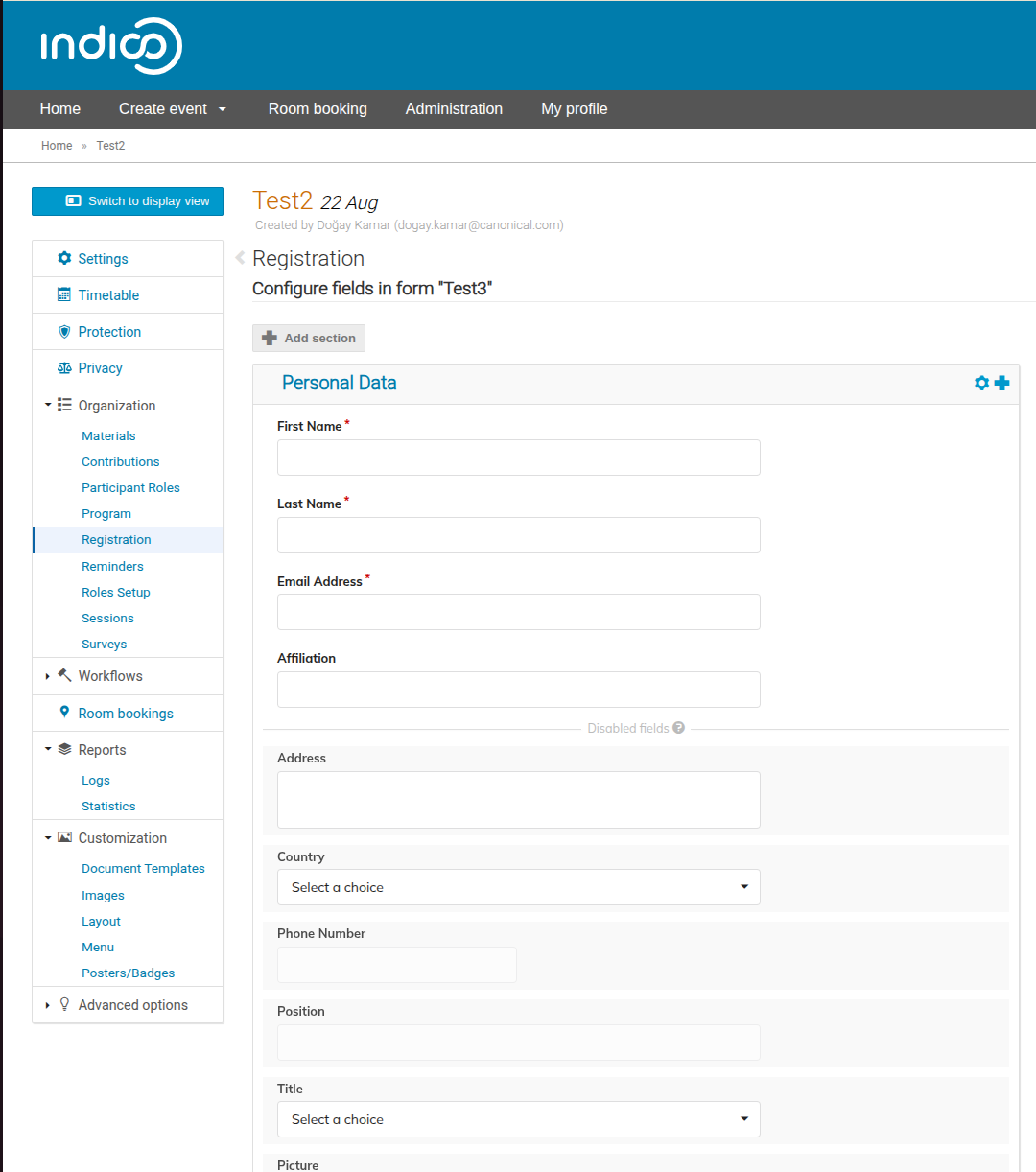
Hello! Following this discussion: Adding new custom fields to user profile
I took the approach of implementing a plug-in to add custom fields. To simplify this example, currently I am trying to add an additional hardcoded field called “Country”:
class CustomProfileForm(IndicoForm):
    """Form for custom profile fields."""

    country = StringField(
        "Country", [Optional()], description="Your country of residence"
    )
However, I am not sure where the best place to include this in the templates is. I don’t think there exists a template-hook as of right now that I can use ( correct me if I am wrong ). So what would be the best approach here? Is it:
1- I can see in indico/modules/users/client/js/PersonalDataForm.jsx that there is a rendering functions for plugin components:
            {renderPluginComponents('user-personal-data-form-inputs', {
              userValues,
              syncedValues,
              lockedFields,
              lockedFieldMessage,
            })}
I haven’t worked with .js before but I assume I have a way of sending the plugin components through user-personal-data-form-inputs entry point? If so, what’s the best way to do it via Indico API?
2- Create a template hook somewhere, contributing to core? I am not sure where though.
3- Override existing template with an HTML of my own? ( Dirtiest approach I assume )
Many thanks for the help!
For reference ( just in case it helps ): This is the current DB model I am using for this particular plugin:
from indico.core.db import db
from indico.modules.users.models.users import User
from indico.util.string import format_repr


class UserCustomProfile(db.Model):
    """Model for storing custom user profile fields."""

    __tablename__ = "user_custom_profiles"
    __table_args__ = (
        db.UniqueConstraint("user_id"),
        {"schema": "plugin_custom_profile_fields"},
    )

    id = db.Column(db.Integer, primary_key=True)
    user_id = db.Column(
        db.Integer, db.ForeignKey("users.users.id"), nullable=False, index=True
    )

    # Professional Information
    country = db.Column(db.String, nullable=True)  # Country of residence

    # Relationships
    user = db.relationship(
        "User",
        lazy=True,
        backref=db.backref(
            "custom_profile", lazy=True, uselist=False, cascade="all, delete-orphan"
        ),
    )

    def __repr__(self):
        """String representation."""
        return format_repr(
            self, "id", "user_id", _text=self.user.full_name if self.user else None
        )

    @classmethod
    def get_for_user(cls, user):
        """Get custom profile for a user, creating if necessary."""
        if isinstance(user, int):
            user = User.get(user)

        if not user:
            return None

        profile = cls.query.filter_by(user_id=user.id).first()
        if not profile:
            profile = cls(user=user)
        return profile